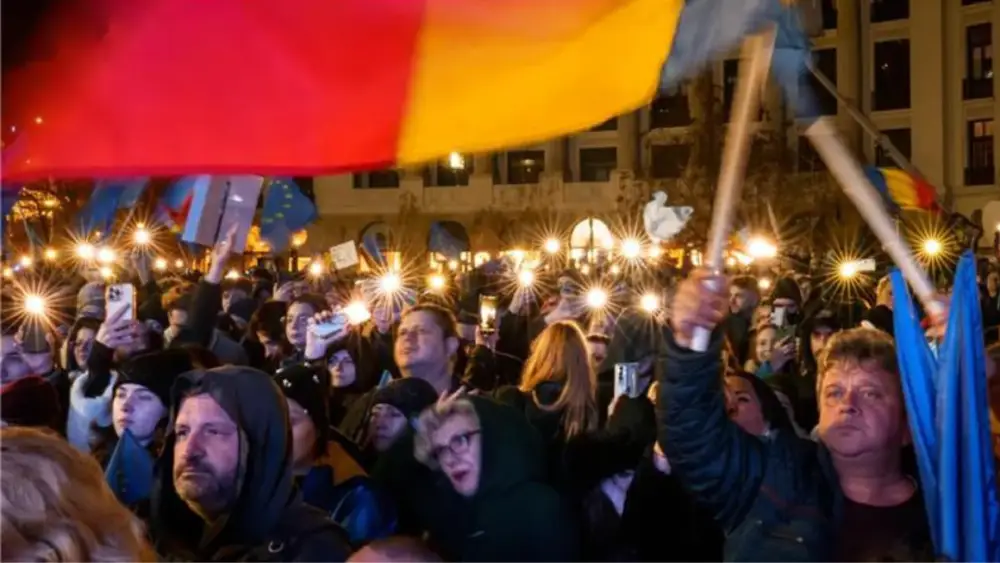
In 2024 Romania’s democracy was threatened. Three Civitates’ partners were integral in protecting it.
The independent candidate Călin Georgescu was polling at around 5% days before Romania’s first-round Presidential election on November 24 last year. When the results were announced, he won with 23% of the vote.
The shock was twofold. A fringe candidate whose campaign was conducted largely through TikTok (and who had declared zero campaign spending), had come from nowhere. And, for many, his ultranationalist populist positions set off alarm bells.
Georgescu has called Romanian fascist leaders national heroes, including Ion Antonescu (who facilitated the Holocaust in Romania during World War II); he’s expressed admiration for Russian President Vladimir Putin; has vowed to jail political opponents; said that Covid and climate change don’t exist; and promised new laws against LGBT+ “propaganda”.
For Romania’s fragile democracy, it appeared to be a moment of jeopardy. After declassified intelligence was released alleging that Georgescu’s campaign had benefited from Russian interference, Romania’s Constitutional Court annulled the result. Georgescu was later barred from running in the rerun of the Presidential election in May 2025.
In the run-up to the November election and its turbulent aftermath, grantee partners from our three sub-funds played integral but differing roles in protecting Romania’s democracy.
From our Civic Power fund, CeRe (Resource Centre for Public Participation), part of the Coalition NGOs for Citizens mobilised Romanian civic society to unite and rise to the challenge of the moment. From our Tech and Democracy fund, Expert Forum (EFOR) uncovered evidence of “coordinated inauthentic behaviour” on TikTok favouring Georgescu. PressOne, from our Media sub-fund, were among the outlets which revealed the forces driving Georgescu’s meteoric rise, and the deep malaise within society that led so many to invest their hopes in him.

Democracy in peril
The first-round result sparked “a feeling of shock and powerlessness,” recalls Oana Preda, Senior Expert at CeRe, which promotes citizens’ participation in the decisions impacting their lives.
“We work in local communities and are very aware of the rise of populism and how easy it is for people to get captured by this ideology, because they’ve been failed by the mainstream political parties and feel abandoned. But the shock was that this anonymous guy won.”
“There was a huge possibility for him to become President. CeRe never express political sympathies, but this was different. It wasn’t just a simple political choice between right and left. Democracy was at threat.”
CeRe, as with the Coalition NGOs for Citizens, took the unprecedented step of mobilising 118 NGOs. Within two days they released a public letter underlining Georgescu’s nature and the threat he posed, while calling on other political parties to firmly stand against him. “We thought this is a crisis and we have to act,” says Preda.
She notes, however, that “[public] anger didn’t disappear with the annulment of the election. It grew bigger.” Meanwhile the pressure on Romanian civil society is tightening, including through smear campaigns and defamation actions aimed to intimidate or silence criticism.
“We have to go on. We have no choice. We’re committed to continue investing in citizens’ power to have their voices heard: showing these aren’t empty words. That democracy is a means of participation which can bring about concrete changes in their lives, whether that means a new school or a new bus.”

Digital illiteracy
Prior to the first-round vote, the Bucharest-based think-tank Expert Forum of Romania monitored the election’s integrity: doing the sort of work that’s been one of its core programmes for the past decade.
For two months before the vote, EFOR analyst Mădălina Voinea was at the heart of a small team, including volunteers, painstakingly researching whether candidates’ digital presence matched the online funding they’re obliged to declare under Romanian electoral law, and using data scraping and other tools to monitor their online campaigning.
They found that Georgescu achieved “levels of virality” on TikTok that it took his rivals 11 months to build (and declared no funding for it).
EFOR’s research became a key source for the investigations into Georgescu that followed, including the European Commission’s investigation into TikTok. “[Romania’s] National Audiovisual Council filed a request to the European Commission based on our research. We’ve given multiple testimonies in the European Parliament, the Commission,” says Voinea. EFOR has also become a signatory of the EU Code of Conduct which implies rapid response mechanisms in cases like the Romanian elections in 2024.
Yet despite uncovering “coordinated inauthentic behaviour” on TikTok and that Georgescu had broken electoral law by declaring no funding, Voinea, like Oana Preda, is uneasy with the decision to annul the election, saying evidence of the interference of Russia, or other malign actors, has not yet been proven.
Voinea points to deeper vulnerabilities within Romanian society.
“We have extremely limited digital knowledge. We are last in the EU’s digital index. And you can see how these vulnerabilities and the desperation for change can be weaponised by transforming social media into a propaganda tool. This digital illiteracy isn’t exclusive to Romania, but it’s particularly bad because TikTok has the greatest user penetration here.”

Discontent
Ioana Epure, editorial director at independent media outfit PressOne, echoes Voinea on the current turmoil’s deeper causes. “He [Georgescu] is the result of many years of collective discontent.The root of the problem is that people are unhappy with their lives. They feel like they have no say in anything that happens in the country. On paper Romania’s GDP has gone up, but for most Romanians this isn’t tangible.”
Food costs have risen 50% in the past five years; the median household income is roughly a third of the EU average; almost a third of the population are at risk of poverty.
PressOne reported on the anger fuelling support for the populist far right in Romania, and Georgescu’s backers. “PressOne’s goal is to always state the facts. Not to feed the machine of disinformation. We tried to understand where he’s coming from. Who’s supporting him. Where he gets the money to operate. We’ve looked at the different angles Georgescu’s ascension could be seen through. One possibility is [that he had the backing of] a fraction of the secret services. He was also supported by a religious group within the Orthodox Church,” says Epure.
PressOne also reported on how Romania’s large diaspora population (20% of the country’s workforce has sought better opportunities abroad in the past decade or so) is turning increasingly to more extreme political parties.
Reporting in a climate of deepening polarisation can be a challenge, says Epure: “Journalists have been threatened when they’ve reported from protests. It’s hard to open a dialogue because they see the media by default as being against them.
No matter how much proof you have, people react emotionally and say you’re making it up. You represent everything they hate. But we keep trying. When everything is going crazy, we go back to our root values: transparent, honest journalism.”
Uncertainty may hang over Romania’s immediate political future – but there’s no question whether CeRe, EFOR and PressOne will continue doing their utmost to protect their country’s hard-won democratic freedoms.
This article is part of Civitates Annual Report 2024, which will be published in May 2024. To discover more stories like this one, stay in touch by signing up for our newsletter using the link below or follow us on LinkedIn.