What does it mean to be a good grantmaker?
In their book Modern Grantmaking, Gemma Bull and Tom Steinberg offer valuable insights into how to be a supportive, transparent and reliable grantmaker – one who makes life easier for grantees rather than more difficult.
Responsible grantmaking, they argue, should be driven by ‘human-centred design’ (HCD). This is “not some grand, airy philosophy”, they write, but rather “a set of working practices” which revolve around “paying close attention to the users of a service”.
Any organisation can adopt and learn these practices, which rest on two crucial elements.
First, continually improving the service that you offer in response to feedback from users (iteration). Second, researching and learning what it feels like to be a grant seeker (user experience research).
This is exactly what we intended to practise with our recent survey gathering feedback from applicants on our recent calls for grant applications in our Civic Power and Technology & Democracy sub-funds.
We carried out the survey following our first open calls in four years, which took place this summer.
What we are doing well
The resounding message we received is that Civitates is a responsive donor.
Respondents expressed a general appreciation of our fairly new team, as well as of the survey itself, noting that few donors ask for feedback on their grant application process.
We organised a series of online information sessions to answer questions that prospective applicants may have. These were deemed useful and were relatively well-attended. Those who couldn’t attend could listen to the recording afterwards on our YouTube channel.
One thing we tried for the first time, was offering non-native English language applicants the chance to use automated translation (and disclose that they did). One used it. We will offer that possibility more widely in the future.
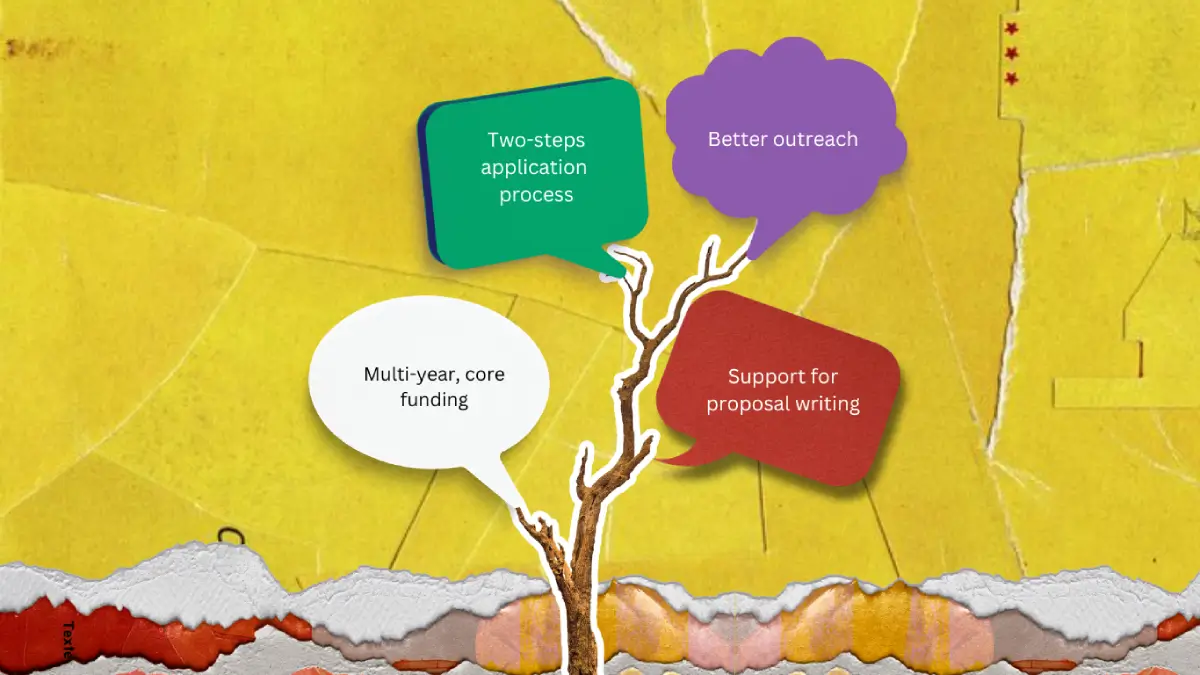
And of course, we received loud and clear appreciation for the multi-year, core funding we provide, and which we remain committed to.
All this should be caveated, however, by the fact that the feedback came only from those who applied for grants, and who took time to respond to the survey. We’re considering whether we reached out enough to organisations who could have been eligible for funding but didn’t know of the call. This could be because they’ve never been funded by Civitates, are outside our circles, they missed the deadline, or perhaps are so underfunded and understaffed that they lacked the capacity to apply. We will double down on our outreach and communications efforts in the future, to ensure that we reach organisations that are not currently on our radar.
Our recent calls in number
Of the 117 grant application proposals we received, 88 were for our Civic Power sub-fund (64 core funding proposals for Europe and 24 project proposals for Austria); 29 were for our Tech & Democracy sub-fund.
We received more outstanding proposals than we are able to fund. For instance, just for our Tech & Democracy sub-fund, at least 10 of the 29 applications we received were excellent, but we will probably be able to support only 6. We would have needed another million euros to be able to fund these 10 excellent initiatives.
This is yet more evidence – as if it were needed – that a huge number of organisations across Europe are doing remarkable work with scant resources to tackle our continent’s deepening political polarisation, its shrinking civic space and its surging tide of disinformation.
Due diligence requirements
Many applicants found the narrative and financial forms easy to fill and most spent an average of 3-5 days completing the whole application process.
However, many among small or medium size organisations found our due diligence requirements more challenging. (“The due diligence questions were far too many compared to other foundations”. “Very high effort, comparatively little funding.”)
Many documents were required as part of the due diligence questionnaire, followed by additional financial and governance related enquiries once the proposal had been shortlisted by the selection committee. This was time consuming.
We will look at ways of addressing this within the framework of the legal requirements of the Network of European Foundations (NEF).
What we will do differently
As we prepare to have another round of open calls in 2025, we are committed to taking the following steps to ensure a more “human-centred” application process:
- Unlike in 2024,we will adopt a two-step application process in 2025. Instead of requesting full proposals from the start, we will do a two-step process where we first request a short concept note, which is quicker to put together for the applicants and quicker for us to read. Only those who have submitted successful concept notes and have been shortlisted will then be invited to submit full proposals. We will do this across all three sub-funds in 2025.
- We will start the process earlier next year. Unlike in 2024, we don’t have to wait for our refreshed strategy to be finalised. What’s more, we won’t do a funding call during the summer, when people should – hopefully – be resting, not writing proposals.
- We will make it clearer that the word count indicated in the narrative form is a recommendation rather than mandatory. It is meant to encourage applicants to distil their points to the essentials, and to enable the team to review many applications but a strict work count can be difficult, especially for non native English speakers.
- We are considering offering some support with proposal writing to short-listed candidates, the shape and form of which still needs to be decided.
- We will invite applicants to ask for grants which are proportional to their annual budget to encourage a wider variety of organisations to apply. We want to ensure organisations can effectively absorb our funding and we also want to get a broader set of applicants operating in more diverse social contexts and with different budget sizes (from very small to relatively large annual budgets).
Starting already this year, the team will endeavour to provide detailed feedback to the applicants who have been shortlisted but not selected, with the hope that this can be a valuable learning and capacity building opportunity for them. Explaining why an application didn’t succeed can be awkward and time-consuming, but we believe it’s also the right thing to do.
Constant learning
While continually trying to learn from our grantees and enhance our grant application processes, we’re also aware that answering calls for proposals is time-consuming and that some organisations are better equipped than others to do so.
Civitates is committed to being fair, transparent, and giving more money to a more diverse set of organisations working to strengthen democracy. We know that so much critically important work is being done that contributes to social change, democratic renewal and press freedom – but which lacks funding.
We are here to help fill this gap.
To do so, we need to keep evolving and challenging ourselves. As the ever-perceptive Gemma Bull and Tom Steinberg note: ‘take no risks, make no impact’.