The proposed AgoraEU programme, a key funding instrument supporting culture, media, democracy and civil society, is under growing pressure. Competing priorities such as defence, competitiveness and fiscal restraint are shaping negotiations, while political scepticism towards civil society funding continues to gain ground. In this context, AgoraEU risks becoming a bargaining chip in wider budget discussions.
However, recent developments show what coordinated advocacy can achieve. Following a joint letter signed by more than 500 organisations, including members of Civitates’ Future of Europe cohort, the European Parliament voted to increase AgoraEU’s budget to €10.72 billion — an increase of €2.14 billion compared to the European Commission’s proposal.
It is a significant signal, but far from a final outcome.
Civitates’ Future of Europe cohort is a unique collaboration that brings together organisations working across media, culture and civic space, combining expertise and experience to make a compelling case for sustained investment in democracy. The coalition includes Culture Action Europe; the European Federation of Journalists; Civil Society Europe; the European Civic Forum; the Centre for Sustainable Media; the Irish Council for Civil Liberties; Centre for Democracy and Technology; and Maldita.es in partnership with Mark Scott.
With key votes imminent, a compressed political timeline, and competing national priorities, the window for action is narrow. The coming months will be decisive in determining whether Europe is willing to invest in the foundations of its own democratic resilience.
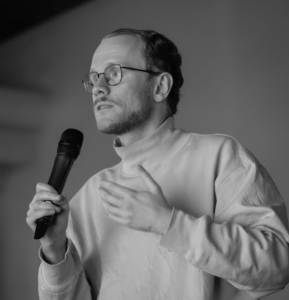
We asked three representatives from across the cohort — Giada Negri (European Civic Forum), Rebecca Bonello Ghio (European Federation of Journalists), and Rhys Nugent (Culture Action Europe) — to share their perspectives on the negotiations, the risks ahead, and why securing long-term funding for civil society and independent media is more critical than ever.
This is quite unique… in that we are able to work more broadly with civil society and culture, which we’ve not really done before. Normally we stay within our own bubble.

What opportunities does this moment create?
Despite the challenges, the negotiations also present a rare window of opportunity. As a new programme, AgoraEU offers the chance to embed stronger protections and priorities from the outset.
For civil society, this includes long-standing demands such as a dedicated protection mechanism for organisations and human rights defenders under attack — a proposal that has gained traction among policymakers. There are also encouraging signs of renewed openness to structured dialogue between EU institutions and civil society, including calls to reinstate the Civil Society Dialogue Group.
At the same time, bringing together culture, media, journalism and civic actors under one framework opens the door to deeper collaboration. As Rhys Nugent notes, this is not only symbolic: it creates real potential for new ideas, stronger synergies, and more coordinated approaches across sectors that are often interconnected but rarely aligned in policy and funding terms.
The risk is that once the numbers are crunched and compromises are needed – because the Parliament is calling for a bigger overall budget – what will be prioritised?

What risks remain in the negotiation process?
Significant risks continue to shape the negotiations. Political pressure on civil society is intensifying, including through mechanisms such as the European Parliament’s Scrutiny Working Group, which stakeholders warn is reinforcing negative narratives and pushing restrictive proposals. These dynamics risk influencing both the outcome of the MFF negotiations and the broader operating environment for civil society across Europe.
Diverging positions between EU institutions also pose challenges. As Rebecca Bonello Ghio highlights, the Council and Parliament may pursue different architectures, priorities and funding levels, reflecting the varied positions of member states. In this context, broader political trends — including pressures on media freedom in several countries — add further uncertainty.
There is also a growing concern that different sectors may be placed in competition with one another for limited resources. As Bonello Ghio puts it: “I think the risk comes from… a very natural reaction to start to see the different strands being pitted against each other.”
For Rhys Nugent, another key risk lies in the gap between political rhetoric and financial commitment: “I fear a lack of political prioritisation… at some point you need to put your money where the mouth is.”
Without clear earmarking and prioritisation, there is a danger that ambition is diluted in the final outcome.
“We face similar struggles, and we also have shared values and shared goals. But rarely do we have the opportunities to collaborate and advocate together at the European level.”
Why coordinated advocacy matters
In this context, the added value of coordinated advocacy has been striking. By bringing together civil society, media and cultural actors, the Future of Europe cohort has significantly amplified its collective voice.
Within weeks, the coalition mobilised hundreds of organisations behind a shared position, while also equipping them to engage directly with policymakers at national and EU levels. This has created a powerful multiplier effect, strengthening both visibility and influence.
Beyond mobilisation, the collaboration has enabled rapid information-sharing, joint analysis, and coordinated responses to emerging developments. As Giada Negri notes: “This collaboration between the different organisations has been really welcomed by policymakers… that we came together as the different stakeholders of the programme with a collective position…[and were able to] come together with a position on emerging issues very quickly.”
For participants, it has also fostered a shift from fragmentation to alignment. As Rhys Nugent reflects: “We face similar struggles, and we also have shared values and shared goals. But rarely do we have the opportunities to collaborate and advocate together at the European level.”
Looking ahead
The outcome of these negotiations will shape the future of Europe’s democratic ecosystem for years to come. While the risks are real, so too is the growing momentum behind a stronger, more coordinated push to secure the funding that civil society, independent media and the cultural sector need to thrive.
If sustained, this collective effort offers not only a path to protect existing support, but an opportunity to reimagine how Europe invests in the foundations of its democracy — with greater ambition, alignment, and impact.